Learn from Seneca quotes that pack wisdom into every word. Jump into life’s profound lessons and timeless insights from the great Stoic philosopher.
Seneca was a Roman philosopher, playwright, and statesman who lived during the first century AD.
Born in Corduba (modern-day Córdoba, Spain), he spent much of his life in Rome, navigating the complexities of politics and power during the reigns of emperors like Caligula, Claudius, and Nero.
Despite his high status, Seneca’s life was far from easy. He faced exile, political plots, personal loss, and, ultimately, was forced to take his own life, ordered by Nero, the very emperor he had once advised.
Seneca, alongside other Stoic greats like Zeno of Citium, Marcus Aurelius, and Epictetus, is best known for his connection to Stoicism, a philosophy that emphasizes self-control, rationality, and finding peace amid life’s uncertainties.
Stoicism is about mastering the art of living, embracing what you can control, and gracefully letting go of the rest. It’s not about being emotionless (contrary to popular belief), but about mastering our emotions to live better lives.
Think of it as the OG life-hack system, long before podcasts and self-help books took over our lives.
Seneca wasn’t just all talk; he lived through some seriously tough times.
Exiled to a desolate island for eight long years, he dealt with political drama, heartbreak, and unimaginable pressure. But somehow, he managed to rise above it all.
His letters and essays weren’t filled with fancy ideas; they were real, down-to-earth reflections and advice.
He wrote about the kind of stuff we all face: dealing with anxiety, coming to terms with death, controlling anger, and finding happiness in the little things.
What makes Seneca’s wisdom stand out, even today, is how timeless and relatable it feels.
He speaks about universal human experiences: fear, failure, love, ambition, and how to live a meaningful life.
The struggles Seneca went through give his words a depth that feels so real and relatable. His wisdom is practical, poetic, and surprisingly modern.
He believed in living with meaning and taking life as it comes, a truth that still feels just as powerful, even after 2,000 years.
As for me, his words feel alive; they practically jump off and tap me on the shoulder, asking me to rethink, recalibrate, and maybe even chuckle at life’s absurdity. Let me share some of his most powerful quotes that have left a mark on me.
Seneca Quotes to Live By
Life, it is thanks to death that you are precious in my eyes.
True happiness is to understand our duties toward God and man; to enjoy the present, without anxious dependence upon the future; not to amuse ourselves with either hopes or fears but to rest satisfied with what we have, which is sufficient, for he that is so wants nothing.
The greatest blessings of mankind are within us and within our reach. A wise man is content with his lot, whatever it may be, without wishing for what he has not.
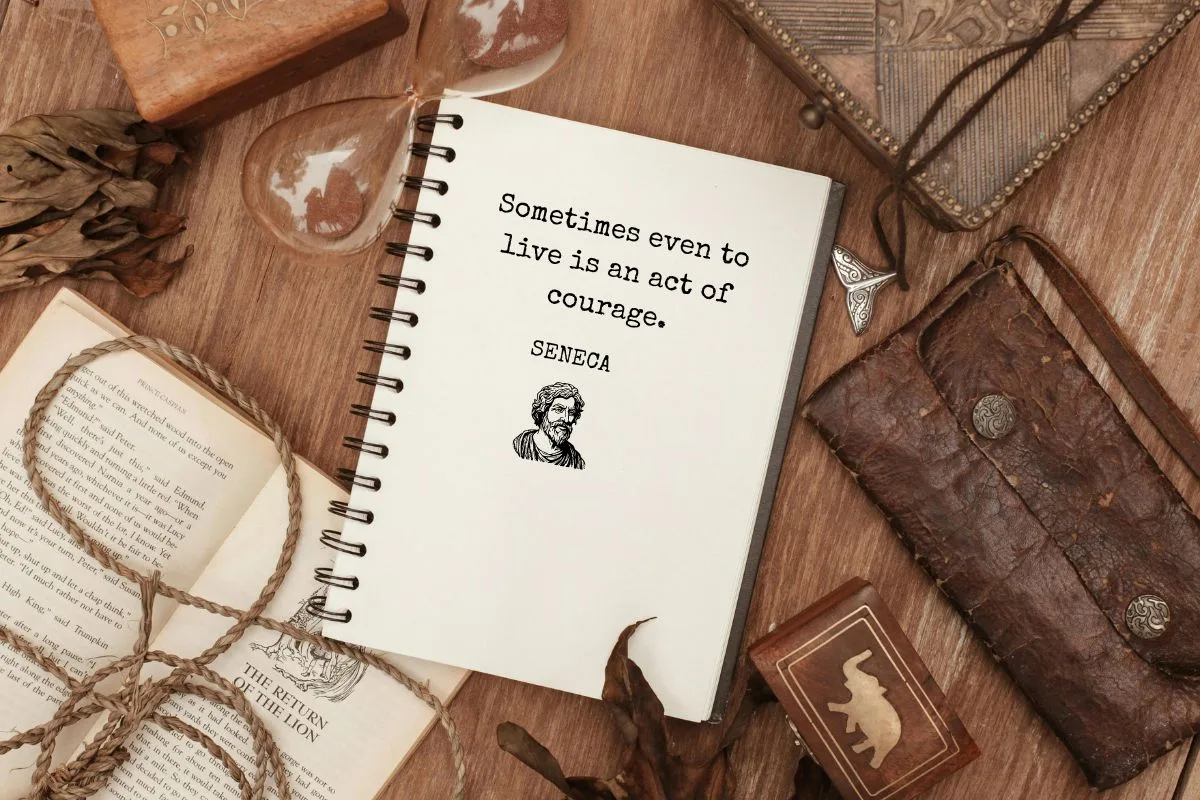
Sometimes even to live is an act of courage.
Every new beginning comes from some other beginning’s end.
It takes the whole of life to learn how to live, and -what will perhaps make you wonder more – it takes the whole of life to learn how to die.
There is no easy way from the earth to the stars.
To be always fortunate, and to pass through life with a soul that has never known sorrow, is to be ignorant of one half of nature.
We learn not in the school, but in life.
You ask what is the proper limit to a person’s wealth? First, having what is essential, and second, having what is enough.
Religion is regarded by the common people as true, by the wise as false, and by rulers as useful.
The best ideas are common property.
If what you have seems insufficient to you, then though you possess the world, you will yet be miserable.
The difficulty comes from our lack of confidence.
As far as I am concerned, I know that I have lost not wealth but distractions. The body’s needs are few: it wants to be free from cold, to banish hunger and thirst with nourishment; if we long for anything more we are exerting ourselves to serve our vices, not our needs.
Luck is what happens when preparation meets opportunity.
Just as with storytelling, so with life: it’s important how well it is done, not how long.
As is a tale, so is life: not how long it is, but how good it is, is what matters.
Life is like a play: it’s not the length, but the excellence of the acting that matters.
All cruelty springs from weakness.
But when you are looking on anyone as a friend when you do not trust him as you trust yourself, you are making a grave mistake, and have failed to grasp sufficiently the full force of true friendship.
There is no enjoying the possession of anything valuable unless one has someone to share it with.
You act like mortals in all that you fear, and like immortals in all that you desire.
To be everywhere is to be nowhere.
When a person spends all his time in foreign travel, he ends by having many acquaintances, but no friends.
As it is, instead of travelling you are rambling and drifting, exchanging one place for another when the thing you are looking for, the good life, is available everywhere.
Where you arrive does not matter so much as what sort of person you are when you arrive there.
Whatever your destination you will be followed by your failings.
Those who wish their virtue to be advertised are not striving for virtue but for renown. Are you not willing to be just without being renowned? Nay, indeed you must often be just and be at the same time disgraced. And then, if you are wise, let ill repute, well won, be a delight. Farewell.
What progress, you ask, have I made? I have begun to be a friend to myself.
It is difficult to bring people to goodness with lessons, but it is easy to do so by example.
Of this one thing make sure against your dying day – that your faults die before you do.
Happy is the man who can make others better, not merely when he is in their company, but even when he is in their thoughts!
To win true freedom, you must be a slave to philosophy.
For many men, the acquisition of wealth does not end their troubles, it only changes them.
Nothing, to my way of thinking, is a better proof of a well ordered mind than a man’s ability to stop just where he is and pass some time in his own company.
Let us say what we feel, and feel what we say; let speech harmonize with life.
Putting things off is the biggest waste of life: it snatches away each day as it comes, and denies us the present by promising the future.
A gift consists not in what is done or given, but in the intention of the giver or doer.
If you have nothing to stir you up and rouse you to action, nothing which will test your resolution by its threats and hostilities; if you recline in unshaken comfort, it is not tranquillity; it is merely a flat calm.
Men do not care how nobly they live, but only for how long, although it is within the reach of every man to live nobly, but within no man’s power to live long.
Soft living imposes on us the penalty of debility; we cease to be able to do the things we’ve long been grudging about doing.
What is harder than rock? What is softer than water? Yet hard rocks are hollowed out by soft water?
It is better to be despised for simplicity than to suffer agonies from everlasting pretense.
It is a rough road that leads to the heights of greatness.
The greatest obstacle to living is expectancy, which hangs upon tomorrow and loses today. You re arranging what is in Fortune’s control and abandoning what lies in yours.
Expecting is the greatest impediment to living. In anticipation of tomorrow, it loses today.
They lose the day in expectation of the night, and the night in fear of the dawn.
Nothing is more honorable than a grateful heart.
I judge you unfortunate because you have never lived through misfortune. You have passed through life without an opponent—no one can ever know what you are capable of, not even you.
Drunkenness is nothing but voluntary madness.
People who know no self-restraint lead stormy and disordered lives, passing their time in a state of fear commensurate with the injuries they do to others, never able to relax.
The more a mind takes in the more it expands.
Whatever can happen at any time can happen today.
What are you looking at? To what goal are you straining? The whole future lies in uncertainty: live immediately.
Brave men rejoice in adversity, just as brave soldiers triumph in war.
He who is brave is free.
When a mind is impressionable and has none too firm a hold on what is right, it must be rescued from the crowd: it is so easy for it to go over to the majority.
What need is there to weep over parts of life? The whole of it calls for tears.
All this hurrying from place to place won’t bring you any relief, for you’re traveling in the company of your own emotions, followed by your troubles all the way.
Throw aside all hindrances and give up your time to attaining a sound mind.
But life is very short and anxious for those who forget the past, neglect the present, and fear the future.
It is a great thing to know the season for speech and the season for silence.
The mind that is anxious about future events is miserable.
He suffers more than necessary, who suffers before it is necessary.
If a man knows not to which port he sails, no wind is favorable.
It is the power of the mind to be unconquerable.
Most powerful is he who has himself in his own power.
It is not the man who has too little, but the man who craves more, that is poor.
If you live in harmony with nature you will never be poor; if you live according what others think, you will never be rich.
No man is crushed by misfortune unless he has first been deceived by prosperity.
Hang on to your youthful enthusiasms — you’ll be able to use them better when you’re older.
It is quality rather than quantity that matters.
Difficulties strengthen the mind, as labor does the body.
Begin at once to live, and count each separate day as a separate life.
We are more often frightened than hurt; we suffer more often in imagination than in reality.
There are more things to alarm us than to harm us, and we suffer more often in apprehension than reality.
Until we have begun to go without them, we fail to realize how unnecessary many things are. We’ve been using them not because we needed them but because we had them.
The fool, with all his other faults, has this also, he is always getting ready to live.
It is not what you endure that matters, but how you endure it.
Anger, if not restrained, is frequently more hurtful to us than the injury that provokes it.
The willing, destiny guides them. The unwilling, destiny drags them.
The cause of anger is the belief that we are injured; this belief, therefore, should not be lightly entertained. We ought not to fly into a rage even when the injury appears to be open and distinct: for some false things bear the semblance of truth. We should always allow some time to elapse, for time discloses the truth.
What really ruins our character is the fact that none of us looks back over his life.
No man can be sane who searches for what will injure him in place of what is best.
I never spend a day in idleness; I appropriate even a part of the night for study. I do not allow time for sleep but yield to it when I must, and when my eyes are wearied with waking and ready to fall shut, I keep them at their task.
I have withdrawn not only from men, but from affairs, especially from my own affairs; I am working for later generations, writing down some ideas that may be of assistance to them.
To expect punishment is to suffer it and to earn it is to expect it.
It is a denial of justice not to stretch out a helping hand to the fallen; that is the common right of humanity.
No man was ever wise by chance.
Envy of other people shows how they are unhappy. Their continual attention to other’s behavior shows how they are boring.
A man is as unhappy as he has convinced himself he is.
It is not that we have a short time to live, but that we waste a lot of it. Life is long enough, and a sufficiently generous amount has been given to us for the highest achievements if it were all well invested. But when it is wasted in heedless luxury and spent on no good activity, we are forced at last by death’s final constraint to realize that it has passed away before we knew it was passing.
So it is: we are not given a short life but we make it short, and we are not ill-supplied but wasteful of it… Life is long if you know how to use it.
The shortest route to wealth is the contempt of wealth.
Fire tests gold, suffering tests brave men.
Love sometimes injures. Friendship always benefits, After friendship is formed you must trust, but before that, you must judge.
What fortune has made yours is not your own.
Withdraw into yourself, as far as you can. Associate with those who will make a better man of you. Welcome those whom you yourself can improve. The process is mutual; for men learn while they teach.
To wish to be well is a part of becoming well.
However much you possess there’s someone else who has more, and you’ll be fancying yourself to be short of things you need to the exact extent to which you lag behind him.
I am not born for one corner; the whole world is my native land.
Injustice never rules forever.
Leisure without books is death, and burial of a man alive.
It does not matter how many books you have, but how good the books are which you have.
There is no genius without a touch of madness.
Wherever there is a human being, there is an opportunity for kindness.
Wherever there is a human being, there is an opportunity for crisis.
Only time can heal what reason cannot.
A guilty person sometimes has the luck to escape detection, but never to feel sure of it.
For what prevents us from saying that the happy life is to have a mind that is free, lofty, fearless and steadfast – a mind that is placed beyond the reach of fear, beyond the reach of desire, that counts virtue the only good, baseness the only evil, and all else but a worthless mass of things, which come and go without increasing or diminishing the highest good, and neither subtract any part from the happy life nor add any part to it?
A man thus grounded must, whether he wills or not, necessarily be attended by constant cheerfulness and a joy that is deep and issues from deep within, since he finds delight in his own resources, and desires no joys greater than his inner joys.
While we are postponing, life speeds by.
Nothing, Lucilius, is ours, except time. We were entrusted by nature with the ownership of this single thing, so fleeting and slippery that anyone who will can oust us from possession. What fools these mortals be! They allow the cheapest and most useless things, which can easily be replaced, to be charged in the reckoning, after they have acquired them; but they never regard themselves as in debt when they have received some of that precious commodity, – time! And yet time is the one loan which even a grateful recipient cannot repay.
Were all the geniuses of history to focus on this single theme, they could never fully express their bafflement at the darkness of the human mind. No person would give up even an inch of their estate, and the slightest dispute with a neighbor can mean hell to pay; yet we easily let others encroach on our lives—worse, we often pave the way for those who will take it over. No person hands out their money to passersby, but to how many do each of us hand out our lives! We’re tight-fisted with property and money, yet think too little of wasting time, the one thing about which we should all be the toughest misers.
Preserve a sense of proportion in your attitude to everything that pleases you, and make the most of them while they are at their best.
Silence is a lesson learned through life’s many sufferings.
Enjoy present pleasures in such a way as not to injure future ones.
How does it help…to make troubles heavier by bemoaning them?
Man’s ideal state is realized when he has fulfilled the purpose for which he is born. And what is it that reason demands of him? Something very easy-that he live in accordance with his own nature.
The man who has anticipated the coming of troubles takes away their power when they arrive.
It does not matter what you bear, but how you bear it.
To bear trials with a calm mind robs misfortune of its strength and burden.
We should not, like sheep, follow the herd of creatures in front of us, making our way where others go, not where we ought to go.
He who indulges in empty fears earns himself real fears.
It is better to conquer our grief than to deceive it. For if it has withdrawn, being merely beguiled by pleasures and preoccupations, it starts up again and from its very respite gains force to savage us. But the grief that has been conquered by reason is calmed for ever.
I am not therefore going to prescribe for you those remedies which I know many people have used, that you divert or cheer yourself by a long or pleasant journey abroad, or spend a lot of time carefully going through your accounts and administering your estate, or constantly be involved in some new activity. All those things help only for a short time; they do not cure grief but hinder it. But I would rather end it than distract it.
If you really want to escape the things that harass you, what you’re needing is not to be in a different place but to be a different person.
As long as you live, keep learning how to live.
Two elements must therefore be rooted out once for all, – the fear of future suffering, and the recollection of past suffering; since the latter no longer concerns me, and the former concerns me not yet.
Wealth is the slave of a wise man. The master of a fool.
No man is more unhappy than he who never faces adversity. For he is not permitted to prove himself.
The sun also shines on the wicked.
It’s not because things are difficult that we dare not venture. It’s because we dare not venture that they are difficult.
The growth of things is a tardy process and their undoing is a rapid matter.
He who spares the wicked injures the good.
You should … live in such a way that there is nothing which you could not as easily tell your enemy as keep to yourself.
For wisdom does not lie in books. Wisdom publishes not words but truths – and I’m not sure that the memory isn’t more reliable when it has no external aids to fall back on.
No man’s good by accident. Virtue has to be learnt.
Pleasure is a poor and petty thing. No value should be set on it: it’s something we share with dumb animals – the minutest, most insignificant creatures scutter after it.
Glory’s an empty, changeable thing, as fickle as the weather.
Poverty’s no evil to anyone unless he kicks against it.
Death is not an evil. What is it then? The one law mankind has that is free of all discrimination.
Superstition is an idiotic heresy: it fears those it should love: it dishonours those it worships. For what difference does it make whether you deny the gods or bring them into disrepute?’
Philosophy has no business to supply vice with excuses; a sick man who is encouraged to live in a reckless manner by his doctor has not a hope of getting well.
That’s Seneca for you, straight to the point and endlessly wise. Live these, and let his words guide you through life’s twists and turns. Share these, and let the wisdom spread.
Quotes by Seneca Worth Pinning for Everyday Wisdom