Ever stumbled on a word that just felt right? This post explores 15 beautiful English words that sound just as lovely as they mean: rare, poetic, and quietly unforgettable.
I hoard words like some people hoard fridge magnets or tea blends. (Full disclosure: I hoard magnets, too. My fridge is basically a scrapbook of everywhere I’ve been and everything I’ve felt.)
If a word sounds lovely, feels warm, means something beautiful or powerful, or makes me pause mid-scroll, it gets a permanent spot in my notes app, in my diary, or on a Post-it, and I later forget where I stuck.
I’ve picked up words from books, signs, overheard conversations, and yes, street menus in far-off cities.
Whenever I feel something new, some oddly specific feeling I can’t quite explain, I Google it (because finding the right word is my version of emotional decluttering).
Not the feeling, the word for the feeling.
That’s how I’ve ended up with a more emotional than academic vocabulary.
It’s also how I discovered Komorebi, the Japanese word for sunlight filtering through trees. I was walking through a forest trail in Uttarakhand, leaves above me, light dancing like it knew choreography, and I just had to know if there was a word for that. There was.
That’s how much I love language.
So now that I finally have a blog about words (yes, Wordista is officially a thing!), I couldn’t not share my little collection.
The first in the series was a list of beautiful bookish words I’ve loved forever.
Then came foreign words that English gave up on translating, the kind I picked up from books, bakeries, bus stops, and sometimes… strangers who didn’t know I was listening.
This one is about the pure English language, the kind of words that feel like a soft breeze, a sweet ache, or a deep breath.
Also, funnily enough, while curating this list, I realized how many of these ‘pure English’ beauties are actually Latin and Greek loanwords in disguise, so if that intrigues you, you’ll love this deep dive into Latin words in English and Greek words in English.
There are a few words that give you a strange comfort. Like they already know you. They’re not loud or needy. They slip into your day, unnoticed at first, and then suddenly, you wonder how you ever expressed anything without them.
These are my favorite words in the English language. I know… I know, I say they’re beautiful, but maybe you won’t think so. You might read through and go, “Meh, I have my own list.” And you know what? Fair. This is a deeply personal thing.
But if you ask how I picked these particular fifteen, here’s my totally unscientific, extremely personal, slightly chaotic method: If a word sounds like music, reads like art, and makes me stop what I’m doing just to whisper it aloud, it makes a list.
If it stays with me after I close the book, if it looks nice next to my tea mug, if I’d scribble it on a paper napkin at a cafe, it belongs here.
So, let’s get to it.
1. Eudaemonia (yoo-dee-MOH-nee-uh)
✨ A word that feels like quiet joy with deep roots. Less fireworks, more fireplace. Not a mood, it’s a state of being where your soul exhales.
Part of speech: Noun
Definition: A state of long-term happiness, flourishing, or well-being; not just feeling good, but living well.
Rooted in: From ancient Greek eudaimonía, meaning “having a good spirit” (eu = good, daimon = spirit or guiding force). It was central to Aristotle’s philosophy of the good life, a life lived with virtue, meaning, and inner alignment.
How It Found Me (Not the Other Way Around): I kept seeing this word pop up in books that talk about purpose, not just happiness. I was curious because it didn’t sound soft like “bliss” or intense like “ecstasy.” It had a steadiness to it, like a word that stays even when the mood changes. I looked it up, and it clicked. This was the word I’d been looking for to describe the kind of contentment that doesn’t depend on how your Tuesday’s going.
What Makes It Beautiful: This word hums with ancient wisdom. It rolls off the tongue with grace and evokes a life well-lived, not in fleeting highs, but in deep, enduring joy. The sound rises and falls like deep breathing. Its structure feels full, its syllables weighty but never heavy. It shapes a kind of inner alignment we often feel but rarely name.
Why It Stays With Me: Eudaemonia has a steadiness and glow that most “happy” words lack. Real happiness doesn’t always look loud, and it’s not always Instagrammable. Sometimes, it’s a life that feels right when no one’s watching. Knowing there’s a word for that makes me feel like I’m already closer to living it.
Use it like this: “Forget resolutions, I’m chasing eudaemonia this year. Quiet, consistent, and deeply mine.”
2. Halcyon (HAL-see-uhn)
✨ A word that feels like a sigh from summer, sounds like a slow breeze over still water, and carries the weight of tranquil memory. Calm, golden, unbothered. The peace that doesn’t ask for attention but settles in. There’s a quiet elegance in halcyon.
Part of speech: Adjective
Definition: Calm, peaceful, nostalgic, and happy, this word is often used to describe a serene time in the past that feels golden in memory.
Rooted in: From Latin halcyonius and Greek alkyōn, a mythical bird (often linked to the kingfisher) said to calm the sea while nesting. Over time, the name flew beyond the bird and came to describe a tranquil state of being.
How It Found Me (Not the Other Way Around): I heard someone say, “Those were my halcyon days,” and I paused…not because I didn’t know what they meant, but because the word sounded like the feeling they were describing. I looked it up anyway (because obviously), and now it lives in my word bank for everything that feels quietly perfect in hindsight.
What Makes It Beautiful: It’s soft and steady, like the feeling it describes. The “hal” glides in, the “see” opens like a pause, and the “uhn” fades gently, like the end of a warm thought. It makes peace sound like poetry. It softens the edges of memory. And saying “halcyon” feels like a gentle quietness, like time took a nap. Seriously, say it out loud.
Why It Stays With Me: Every time I hear it, I think of slow breakfasts on old balconies, summer evenings that stretched longer than they should’ve, and one beach trip where the wind didn’t mess up anyone’s hair. It takes me back to moments that were too still and golden to notice at the time. I only realized how peaceful they were much later, when life got louder.
Use it like this: “We stayed in a little village by the sea, where time moved slowly, and life felt halcyon.”
3. Selenian (suh-LEE-nee-uhn)
✨ A word that glows, like moonlight on water or silence that feels full instead of empty. Pale, still, and slightly enchanted, it whispers like silver and reads like a spell.
Part of speech: Adjective
Definition: Relating to the moon; moon-like in appearance or quality.
Rooted in: From Selene, the Greek goddess of the moon. The suffix -ian turns it into something belonging to or resembling her celestial, silvery, and softly distant.
How It Found Me (Not the Other Way Around): I was writing a line in my journal and wanted to describe something that didn’t shine like the sun, but shimmered quietly—a word for things that glow softly in the dark. I typed “moon-like” and cringed. Too plain. So I searched: “beautiful word for moon-like.” And there it was, Selenian. It felt like finding a secret passage in an ancient, pretty book.

What Makes It Beautiful: Selenian sounds precisely like what it means: soft, slow, and a little otherworldly. The “sell” brushes past like moonlight, and the ending drifts off like mist. Some words shine. This one reflects, and that subtlety makes it unforgettable. Not everything beautiful needs to be bright.
Why It Stays With Me: I’ve always had a thing for the moon. When I see it from my balcony, full or just a sliver, I feel a strange stillness that’s hard to name. Selenian gives me a word for those nights when the sky is clear, the world is hushed, and everything feels like it’s glowing from the inside out.
Use it like this: “She had that selenian kind of glow, soft, serene, and impossible to look away from.”
4. Iridule (IR-ih-dyool)
✨ A word that flickers like light on bubbles. Delicate, visual, fleeting, and almost imaginary, like catching color where you least expect it, it looks and sounds like a glint of magic.
Part of speech: Noun
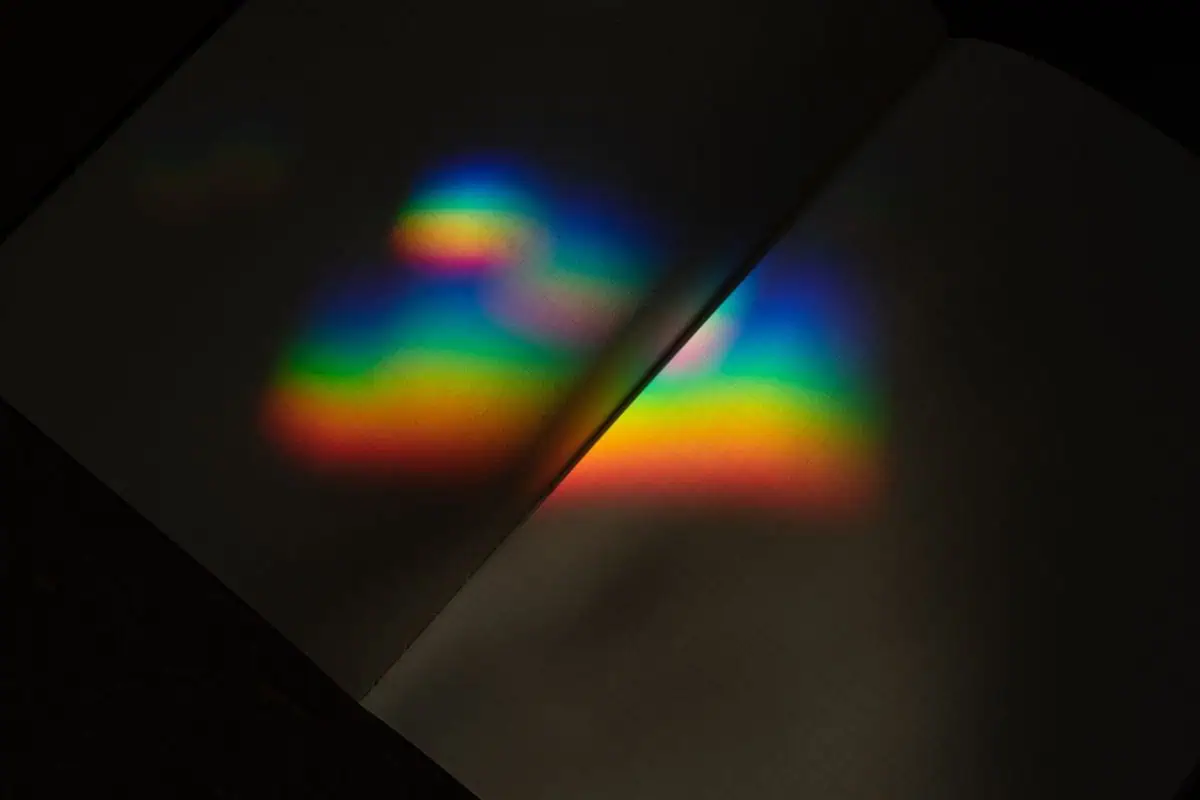
Definition: A subtle rainbow-like shimmer or gleam, often seen on soap bubbles, oil slicks, or frost; a subtle play of colors
Rooted in: From Latin īris (rainbow) + the diminutive suffix -ule, meaning “a little.” Literally: a little rainbow.
How It Found Me (Not the Other Way Around): I was watching the sun hit a puddle and suddenly there it was…that dreamy, oily swirl of color I’ve seen a hundred times but never had a name for. I Googled something dramatic like “micro rainbow on water,” and iridule peeked out like it had been quietly waiting for someone to ask.
What Makes It Beautiful: There’s a flicker in iridule, in the word itself, and in what it describes. The soft “iri” dances like light on soap film, and the tiny “-dule” tucks it away like a secret. It’s delicate and nearly invisible, but when it shows up, on bubbles, puddles, and glass, it feels like color just decided to play. It feels like catching something you weren’t supposed to see, but did.
Why It Stays With Me: A kind of magic hides in everyday corners, which most people miss. Iridule holds those moments. The shimmer on a bubble, the rainbow trapped on a windshield, the flicker of color on rain-soaked concrete. Whenever I spot it, I feel like I’ve uncovered a secret, small, fleeting, and quietly fabulous.
Use it like this: “The puddles after rain were laced with iridules, like the sky had left its fingerprints behind.”
5. Lissome (LISS-um)
Lissome (LISS-um)
✨ A word that moves like silk in slow motion. Light, elegant, unforced. The kind of beauty you notice in the way someone walks, not the clothes they wear.
Part of speech: Adjective
Definition: Graceful, supple, flexible, and effortlessly agile in movement or manner.
Rooted in: A blend of lithe and some, first appearing in the 18th century. Basically, “lithe-some” and yes, it’s as graceful as it sounds.
How It Found Me (Not the Other Way Around): I came across it while reading something about ballet, not the stage kind, the casual kind. A writer described a dancer’s stretch as lissome, which stopped me. I love it when a word matches how the thing feels in the body. That softness, that stretch, that steady elegance? Lissome nails it.
What Makes It Beautiful: This word is the very sound of elegance in motion. The double “s” slides through, making the word feel fluid and airy. It makes grace feel quiet, not showy. It’s not about perfection but ease, presence, and movement that doesn’t try too hard.
Why It Stays With Me: It captures something I often notice but don’t know how to describe: how some people or things move without fuss or noise, like someone walking gently or a curtain swaying in the breeze. It stayed with me because once I had the word, I started seeing it everywhere. In posture, in movement, even in moods. It’s one of those words that softly becomes part of how you see the world.
Use it like this: “She moved through the room in that lissome way that made everyone slow down without realizing it.”
6. Vellichor (VEL-ih-kor)
✨ A word that feels like yellowed pages, dust motes in sunbeams, and the echo of someone else’s story brushing past yours.
Part of speech: Noun
Definition: The strange wistfulness of secondhand bookstores and the scent of old pages, surrounded by stories once loved, still lingering in the air.
Rooted in: A modern coined word—part vellum (referring to old pages or parchment) + -chor, possibly from sorrow or core. Not etymologically traditional, but emotionally exact. It may be a coined word, but it’s seeped into English usage.
How It Found Me (Not the Other Way Around): It was on a list of “untranslatable feelings,” and I almost skipped it, but the moment I saw “used bookstore,” I was in. I’ve walked into tiny secondhand shops in Paris, Kolkata, and Edinburgh, and every one of them smelled like ink and memory. I didn’t know there was a word for that kind of ache. Turns out, someone had made one.
What Makes It Beautiful: It feels like a whisper. The sound matches the spaces it lives in—low, quiet, and a little haunting. It doesn’t just describe a place, it captures a mood; a whole moment, the bittersweet pull of time and stories left behind. And the word itself is rustic, dusty, and oddly romantic.
Why It Stays With Me: Words don’t always come from dictionaries; sometimes they come from feelings too specific to stay unnamed. Secondhand bookstores have always felt different to me, less about shopping, more about wandering. I don’t go in with a plan. I just follow the feeling. Vellichor gave me a name for that pull. It stayed because I didn’t know I needed a word for that, and now I can’t unknow it.
Use it like this: “I wandered through the aisles, wrapped in vellichor, as if the books were watching me back.”
7. Aubade (oh-BAHD)
✨ A word that rises with the sun and leaves before coffee. It’s love laced with goodbye, wrapped in music and morning mist. It’s morning light turned into sound, with a soft rhythm and a heart full of longing.
Part of speech: Noun
Definition: A poem or song that greets the morning, often capturing the bittersweet parting of lovers at dawn.
Rooted in: From French aubade, drawn from Provençal aubada, meaning “dawn serenade.” Born from the old tradition of lovers singing at sunrise before going their separate ways.
How It Found Me (Not the Other Way Around): I was reading a poem that didn’t even mention the word, but the scene was two people saying goodbye in half-light, and I thought, “Surely there’s a word for this kind of quiet heartbreak at sunrise.” I looked it up. There was.
What Makes It Beautiful: French-born but English-adopted, aubade is sheer lyrical beauty. It’s soft, brief, and almost shy. The “au” opens like a yawn, and the rest trails off like light slipping through curtains. It holds that rare space between newness and nostalgia. It’s delicate in both sound and feeling.
Why It Stays With Me: I’ve always been a morning person. I love how everything feels fresh but not loud. When I found Aubade, it felt like someone had named that stillness, that in-between space when the day has begun but the world hasn’t caught up yet.
Use it like this: “She wrote him an aubade on the last page of her journal, short, gentle, and enough.”
8. Niveous (NIV-ee-uhs)
✨ A word that lands like snow on your sleeve—light, silent, and almost too pretty to touch.
Part of speech: Adjective
Definition: Snowy; resembling or covered in snow.
Rooted in: From Latin niveus, meaning “snowy,” which comes from nix, “snow.” Think classic, untouched, postcard-level white.
How It Found Me (Not the Other Way Around): I was trying to describe a landscape that wasn’t just white, but had that delicate, clean, almost glowing quiet that comes with fresh snow. “White” felt like a color. Niveous felt like a moment.
What Makes It Beautiful: It captures the stillness of snowfall without ever mentioning the weather. It’s the hush, the softness, and the breath-holding beauty of snow before it’s stepped on. As soft and crisp as a winter morning, Niveous feels clean and untouched. It’s a whisper of white, pure and poetic in both meaning and music. It feels soft even before you know what it means. The sounds are light and airy, as if they could float. It doesn’t sound harsh or heavy and melts as you say it.
Why It Stays With Me: I’ve never lived where it snows, but the idea of snow has always felt magical to me. Still, quiet, untouched. When I found niveous, it gave that imagined feeling a word. It made something I’ve only seen in pictures feel real and close.
Use it like this:
“She wore a niveous scarf, and for a second, it looked like winter had dressed her itself.”
9. Apricity (a-PRIS-i-tee)
✨ Quiet, rare, and gently golden…A word that feels like a soft sunbeam on a winter morning, you almost miss it, but once you feel it, you stay a little longer.
Part of speech: Noun
Definition: The warmth of the sun in winter
Rooted in: From Latin aprīcitās, based on aprīcus, which means “sunny” or “warmed by the sun.” First spotted in 1623 when Henry Cockeram, clearly a man who appreciated good sunlight, tossed it into his dictionary of “hard English words.” Sadly, it never caught on. Most people went back to just saying “nice day.” Their loss. It’s now officially archaic, but honestly, too lovely to leave behind.
How It Found Me (Not the Other Way Around): It happened on a winter afternoon in Vienna. I was wrapped in three layers and still shivering when a single golden ray landed on the bench beside me like it had an agenda. I tilted my face toward it, smiling like a weirdo, warmed from the outside in. It was such a specific feeling, I had to ask Google, “Is there a word for sun in winter?” Turns out, there is. And it’s beautiful.
What Makes It Beautiful: Soft on the ear and warmer in meaning, Apricity begins like a secret and ends like a sigh. There’s a roundness to it, like how the sun fills a space slowly.
Why It Stays With Me: It names a moment I never thought had a name. It shows how something soft can still find you even in the coldest spaces. And now, every time sunlight brushes my cheek on a winter day, I don’t just feel warm, I feel seen.
Use it like this: “She stood by the window, soaking in the apricity, pretending spring had arrived early.”

If you love words like apricity that make winter sound bright and beautiful, you’ll adore my post on Beautiful Winter Words.
10. Zephyrean (zeff-EER-ee-uhn)
✨ A word that drifts through sentences like a breeze through open windows, soft, brief, and impossible to hold onto.
Part of speech: Adjective
Definition: Of or relating to a soft, gentle west wind.
Rooted in: From Zephyrus, the Greek god of the west wind, known for his calm, springlike breezes. The word evolved through Latin (Zephyrus) into poetic English as zephyrean.
How It Found Me (Not the Other Way Around): I read it in a line describing someone’s laugh. It was called “zephyrean,” and I paused. I’d never seen laughter described as wind before, but it made sense. There’s something beautiful about softness being powerful enough to move things.
What Makes It Beautiful: Zephyrean sounds exactly like what it is, airy and light, almost a dance. The “zeph” is airy, and the “-ean” trails off like a breeze leaving the room. It calls to mind open skies, springtime afternoons, and barely-there winds that kiss your skin.
Why It Stays With Me: I remember this one evening. There was no noise, no crowd, just me sitting on a terrace after a long, hot day. And suddenly, this breeze came in. It wasn’t strong. It didn’t cool everything down. But it felt like the day had exhaled. That tiny shift made everything feel bearable again. Later, when I found Zephyrean, it took me straight back to that exact moment.
Use it like this: “She had that zephyrean kind of presence, always moving, always gentle, and always missed the moment she was gone.”
11. Evanesce (ev-uh-NESS)
✨ A word that leaves like mist on glass—quiet, graceful, and gone before you realize you miss it.
Part of speech: Verb
Definition: To fade away or vanish gradually, like vapor, light, or a memory slipping from view.
Rooted in: From Latin evanescere, meaning “to disappear or vanish.” It’s where we get evanescent, too, the adjective form that clings to poetry like perfume on air.
How It Found Me (Not the Other Way Around): I came across it while reading a line that said something “evanesced into silence.” I had to stop. I’d never seen the word used like that, but it made sense instantly. I looked it up and whispered it once just to hear how it sounded.
What Makes It Beautiful: There’s poetry in how this word disappears even as you say it. It captures the fragile beauty of fleeting things, like sunsets, dreams, and the last notes of a song.
Why It Stays With Me: It reminds me that not everything needs closure; some things are meant to slip away without warning, without weight, just a gentle blur fading into something else. Conversations, feelings, even faces; they don’t disappear all at once. They just start to soften and fade. Evanesce gave me a word for that quiet kind of letting go.
Use it like this: “The light evanesced behind the clouds, leaving the room in a quiet kind of grey.”
12. Serein (suh-RANE)
✨ A word that feels like a secret whispered by the sky—barely there, but strangely unforgettable.
Part of speech: Noun
Definition: A fine, light rain that falls from a clear sky, often at dusk.
Rooted in: Borrowed from French serein, which means “serene” or “clear,” but oddly enough, it also names this subtle phenomenon where rain falls even when the sky looks empty.
How It Found Me (Not the Other Way Around): I read it in a poem and thought it was a typo. Rain from a clear sky that had happened to me before…walking home, not a cloud in sight, but somehow damp. I’d never questioned it. Then I learned the sky has a word for it.
What Makes It Beautiful: Soft and rare, serein feels like an evening sigh. The spelling is elegant, the meaning impossibly delicate, and its presence is almost invisible yet deeply felt. It reminds me that not everything has to make sense to be real and that beauty can fall gently, quietly, even when no one’s expecting it.
Why It Stays With Me: One evening I was out running an errand, and it started to rain. The sky was still light, no clouds, no smell of rain, just this odd drizzle out of nowhere. I remember standing there, not rushing, not checking the weather, just standing. It felt like a glitch. Quiet, a bit eerie, but also kind of beautiful. I never talked about it. Then I found Serein. And suddenly, that weird little moment had a name.
Use it like this: “She stood under the serein, laughing like the sky had played a trick just for her.”
13. Elysian (ih-LIZ-ee-un)
✨ A word that feels like lying in grass under a sky that forgot how to storm. Pure, still, and maybe just a little bit unreal.
Part of speech: Adjective
Definition: Blissful, heavenly, or idyllic like paradise.
Rooted in: From Elysium, the mythic Greek paradise where the blessed go after death. Over time, Elysian became shorthand for anything dreamlike and serene.
How It Found Me (Not the Other Way Around): It popped up in a line describing music that “sounded Elysian,” and I stopped reading for a second. Not because I didn’t know the word, but because suddenly, it felt right. That soft, slow, no-edges kind of peace.
What Makes It Beautiful: It names the beauty that doesn’t need a spotlight. It’s not dramatic. Just gentle and gold-tinted and whole. Elysian brings a heavenly lightness to the tongue. It’s a word draped in golden hues, often used to describe sublime happiness or idyllic tranquility (think “Elysian fields”). In just three syllables, it evokes a sky without clouds, a life without care. The soft initial vowel and the lilting -ian ending make it musical. It’s not a word you hear often, which makes it feel like a secret. It feels like sharing a tiny, verbal escape, like handing someone a bit of stillness without saying much.
Why It Stays With Me: Once, we stayed in this cabin in the hills, no internet, no schedule, no plan. Just slow days, long walks, and meals we actually sat down for. I didn’t post anything, didn’t write anything, didn’t feel like I was missing anything. That trip comes back to me every time I hear Elysian.
Use it like this: “The light that afternoon was Elysian like the day forgot to rush.”
14. Efflorescence (ef-flor-ESS-ence)
✨ A word that blooms mid-sentence. It doesn’t just describe flowers; it feels like one unfolding in slow motion.
Part of speech: Noun
Definition: The process of flowering or blooming; a moment of full expression and beauty.
Rooted in: From Latin efflorescere, meaning “to begin to bloom.”
How It Found Me (Not the Other Way Around): I saw it in a book review. Someone said the story “reached emotional efflorescence.” I didn’t even finish the sentence. I just stared at the word and whispered it a few times.
What Makes It Beautiful: Efflorescence is a fragrant word, bursting into bloom as you say it. With that gentle flor in the middle, it clearly carries the essence of flowers. Yet it’s not just about petals; it can describe the moment of flourishing in anything: ideas, art, and life. The word feels like a slow opening; it begins and ends softly, with a bright flourish in the middle. In meaning, it reminds us of transformation and growth; in sound, it leaves a lingering sweetness, like the scent of spring in the air. It says growth doesn’t have to be loud; sometimes it’s just something finally becoming itself.
Why It Stays With Me: I once watched someone I care about change slowly, over months, not all at once. More confident, clearer, more like themselves. And no one really noticed, but I did. I remember thinking, This is what blooming looks like. When I found efflorescence, I thought, this is their word.
Use it like this: “There was an efflorescence in her spirit like she finally allowed herself to bloom.”
15. Amaranthine (am-uh-RAN-thin)
✨ A word that sounds like it can’t fade and refuses to. It’s the echo of something eternal, dressed in deep purple.
Part of speech: Adjective
Definition: Unfading; everlasting; eternally beautiful.
Rooted in: From Greek amarantos, meaning “unfading,” + -ine. Named after the mythical amaranth flower that never wilts, and by speaking it, one conjures images of deep purple blossoms and immortal love.
How It Found Me (Not the Other Way Around): I came across it while reading about color theory, but the word felt bigger than paint. It felt like devotion, like memory, like something you can’t explain but never stop feeling.
What Makes It Beautiful: Rich and regal, amaranthine is a word that never withers. Its four melodic syllables and the soft “th” in the middle give it a musical, timeless quality. It is beautiful in both form and meaning: it sounds like something rare and enduring, and it promises forever. It reminds me that some things, love, loss, and longing, don’t go away. They just get folded into who we are.
Why It Stays With Me: I keep certain things long after they stop being useful, a page from an old notebook, a message I never replied to, a birthday card I’ve already memorized. I don’t even know why. I just do. Amaranthine gave me a word for the things I don’t let go of, even when no one else remembers them.
Use it like this: “He wrote her name in amaranthine ink—knowing it wouldn’t fade, even if she did.”
You’ve scrolled this far, so I know one of these words must’ve made you smile, pause, or raise an eyebrow. That counts.
If you’re already thinking of writing one down, maybe using it in a caption, or secretly claiming it as your new favorite, welcome to the club.
Also, if you’re into words that feel like little punches of truth, you’ll probably love this collection of short quotes that sound like truth whispered. Just saying.
So, what’s your word? Which one’s getting a forever home in your notes app today?
Most Beautiful Words in the English Language Pinterest